

During my travels, I’ve been fortunate to see and experience much that is worth sharing.
My hope is that these images touch your hearts, much as the USA’s natural beauty has touched mine.
May the adventurous among you benefit from the travel information I share on these pages!
By the summer of 2021, it had been several years since I first traveled to the Pacific Northwest. Like nearly everyone else in the country, my patience had been tried by a long year of travel restrictions, by the daily news of the Covid-19 epidemic, and by having to wear disposable face masks everywhere other human beings congregated.
When the opportunity to spend three days at Mount Rainier National Park presented itself, I didn’t have to think twice! I’ll always be grateful for the time I spent there.
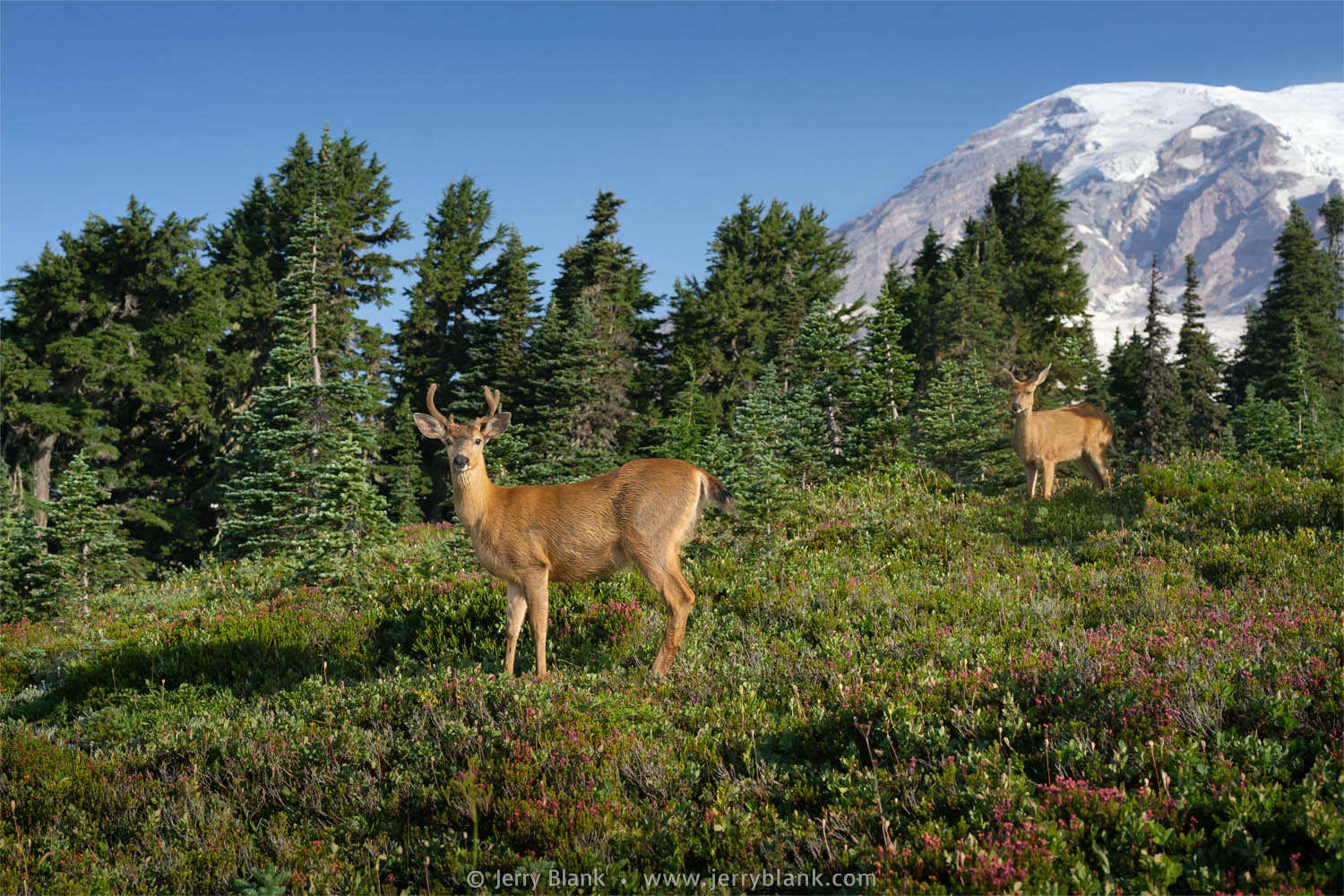
A pair of black-tailed deer graze on the southeast foothills of Mount Rainier — Click / tap image to view full size
I recalled from my earlier journeys that Ashford, a mountain village 14 miles distant from the park’s Paradise day-use area, provided a good balance of available/affordable lodging. Mountains being what they are, the actual driving distance is closer to 23 miles. One can keep the driving time down to about 40 minutes by departing very early in the morning. If there is seasonal road repair work, departing early is the best way to avoid delays. Not long after 8 am, the 2-lane road is usually congested.
Another infrastructure issue is the available parking space at the Paradise visitor center. Simply put, there isn’t enough of it. That’s yet another reason for being an early bird.
The cozy Paradise Inn is only a short walk from the visitor center, at an elevation of 5400 feet, making it an even more ideal place to stay. Convenience, of course, is costly—and one must make Paradise Inn reservations far in advance of their planned trip.
For this trip, I was able to secure lodging in Ashford, where I had stayed years before. Arising bright and early, I made my way to the Paradise parking lot, found the trailhead (Click/tap here to view trail map) and reached the summit of the Alta Vista trail by 8 am. Alta Vista isn’t the highest trail in the area, but it earns its name nonetheless. Its proximity to the visitor center provides expansive views east across Paradise, and south to the jagged peaks of the Tatoosh Range.
I met no other hikers as I approached the viewpoint. The last quarter-mile of the trail is steeper, and I was obliged to slacken my pace. At that point, I noticed that I wasn’t alone: A pair of black-tailed deer had arrived at Alta Vista shortly before I did. They were browsing for breakfast a short way off the trail, and paid little attention to me.
It didn’t take long for me to find my camera, but it wouldn’t have mattered much if it did. In a national park, the wildlife considers us to be part of the scenery, unless we approach them rashly and try to get in their face! One can get a decent picture without a large and heavy telephoto lens, especially before the crowds show up for the day—but if you want a closeup shot with excellent detail, a larger high-quality telephoto is what you’ll need. Compact cameras advertised to have an unusually high zoom range (such as 50x) also happen to have unusually poor image quality.
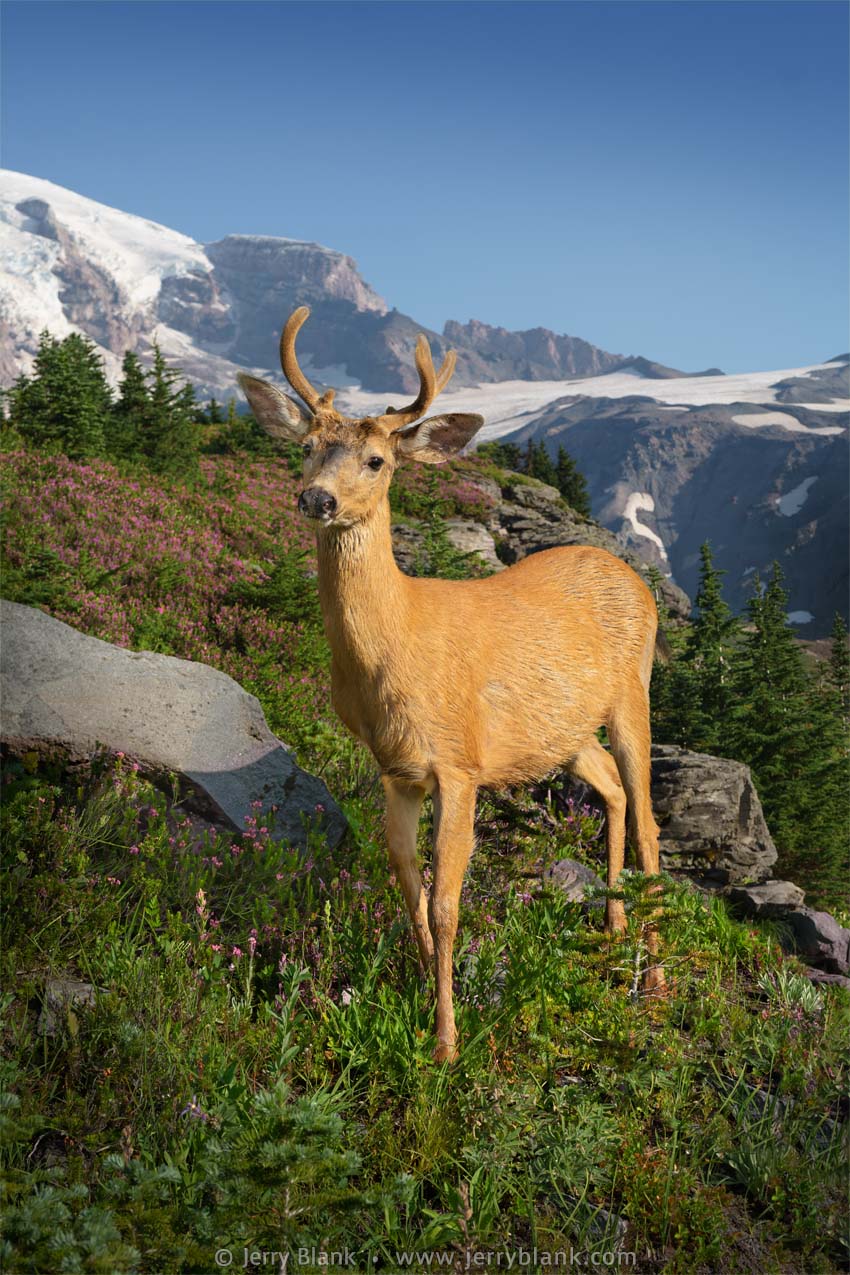
A black-tailed deer buck near the Alta Vista trail, with Nisqually Glacier in the background — Click / tap image to view full size
Even though I’d prepared myself for such a moment, and arrived at a time of day that deer are likely to be seen, I’m still lucky to have had such close company with this pair! The buck, in particular, was willing to pose for another dozen shots, as he moved toward an open area toward the north. I appreciated that, since deer are not as easily seen in Florida—not this closely, anyway.
Afterward, I headed west to explore the Skyline Trail, which is well-named. At its highest point, one can see other volcanic peaks east of Rainier on a clear day. More photos will follow soon.
In the meantime, I’ll share some observations about the stewardship of our public lands:
By the end of my three days at Mount Rainier, it was obvious that the park—actually, the entire national park system—is sorely in need of help from U.S. taxpayers if it’s to be preserved for future generations. Our best national parks are the ones under the most pressure from an ever-increasing number of visitors. Most people aren’t aware of the enormous effort it takes to maintain a natural space in the mountains. Every season, the mountains take back a bit of the roads and trails we carve through them. Cleaning up after the forces of nature, and making these routes safe once again, is hard and costly work. These costs increase with each season. In spite of that, the National Park Service’s budget continues to shrink instead of grow, making it more and more difficult to just to keep the existing trails and the access roads usable. Future improvements are almost entirely out of the picture.
Fortunately, groups such as the National Parks Conservation Association speak out when park budgets are being considered in Washington. But they need much more help from people like us.
Since Microsoft Corp. set up shop in the mid-1980s, the Seattle metro area’s population has nearly doubled. Mount Rainier National Park keeps the population hemmed in on the east, and the Pacific Ocean is an effective barrier to westward expansion. Whenever a few acres of rural real estate does become available, it’s quickly bought by investors and developed. The two-lane state highways which surround the park are burdened to capacity just by local traffic. As traffic increases during the summer travel season, traffic jams are commonplace.
In some parts of Europe, scenic parks in the Alps are served by electric railways and tramways. Building such a low-noise, low-pollution, high-capacity transport system into our national parks would be as legacy as huge as the creation of the parks themselves.
That would also make it possible to access backcountry areas of the parks—areas which few visitors ever get to see. If visitors were provided with a low-impact way to access those views and those trails, they would no longer be restricted to overcrowded areas such as Paradise in Mount Rainier National Park.
Building roads which would carry cars and trucks into the backcountry is off the table, due to the environmental damage that would result. But a more enlightened approach, using electric transport, could be a win-win. As mentioned above, park maintenance needs adequate funding first—but it’s not too soon to plan for the kind of transportation future generations will need. We can’t expect such planning to go far if we expect it to happen from the top down. What the park system is presently getting from the top down is the opposite of what’s needed!
An enlightened approach has to begin at the grassroots level, to be coordinated by organizations such as NPCA, and to be funded at least in part by forward-thinking philanthropists. If it’s done that way, a National Parks infrastructure overhaul will have a better chance of being considered by a future U.S. Congress.
In the meantime, I continue to share my journeys to natural spaces on these pages, in the hope that I can pass a bit of my enjoyment along to you!